|
Glossary
CHAPTER 1. CLIMATE, TERRITORY AND POPULATION
Mean Maximum Temperature
The average daily maximum air temperature, for each month and as an annual statistics, calculated over all years of record.
Mean Minimum Temperature
The long-term average daily minimum air temperature observed during a calendar month and over the year.
Mean Relative Humidity Percent
Humidity is the amount of water vapor in the air. Relative humidity, expressed as a percent,
measures the current absolute humidity relative to the maximum (highest point) for that temperature.
Mean Temperature
The average daily maximum and maximum air temperature, for each month and as an annual statistics,
calculated over all years of record.
Monthly Mean Temperature
The average of the mean monthly maximum and minimum temperatures.
Rainfall
The amount of water falling in rain, snow, etc., within a given time and area,
usually expressed as a hypothetical depth of coverage.
Relative Humidity Percent
Humidity is the amount of water vapor in the air. Relative humidity, expressed as a percent,
measures the current absolute humidity relative to the maximum (highest point) for that temperature.
Catastrophic Occurrences, Losses and Relief
Department of Disaster Management provides relief assistance in cash or/and in kind to those who
suffered from natural and manmade disasters such as fire, floods, cyclone, earthquake, thunderstorm, landslide, conflict and others.
The provision of assistance is based on the amount of destruction which is confirmed by the local administrative authorities or/and regional the Department of Disaster Management.
Causes of Fire and Losses
Fire Services Department is responsible for fire safety activities like fire precaution, fire prevention and firefighting
as well as for search and rescue activities in case of natural disasters and other emergencies. The information related to the response of the
operation and losses of damages are recorded by Fire Services Department.
State
The territory occupied by one of the constituent
administrative districts of nation.
Region
It is a specific area defined by having its own characteristics.
District
States and Regions are divided into districts, which in turn are subdivided into townships then towns, wards and villages.
Township
An administrative division of a country.
Town
An urban area with a fixed boundary that
is smaller than a city or any more urbanized center than the
place of reference.
Ward
A division or district of a city or town,
as for administrative or political purposes.
Village Tract
A group of adjacent villages.
Village
The region where the boundary is stipulated
and formed under the Ward or Village Tract Administration
Law which is not included in the estate within the relevant
town boundary.
Urban Area
Areas classified by the General Administration
Department as wards. Generally these areas have an increased
density of building structures, population and better infrastructural
development.
Rural Area
Areas classified by the General Administration Department as village tracts.
Generally they are areas with low population density and a land use which is predominantly agricultural.
Total Population
It is based on the de facto definition of
population, which counts all persons who were within the borders
of Myanmar on the night of 29th March 2014 (Census Night).
All Myanmar people working in its embassies abroad and their
families were counted in the census. The estimates of people
who were not enumerated in a few areas in Shan State, Kachin
State and Kayin State in the census.
Population Density
The Population density relates to the number of person in a
give administrative area to the surface of the area, expressed
in square kilometers (km2).
Total Dependency Ratio
A measure of the portion of a population
which is composed of dependents (people who are too young
or too old to work). It's equal to the number of people aged
below 15 or above 64 divided by the number of individuals
aged 15 to 64, expressed as a percentage. It is the sum of
the youth dependency ratio and the old-age dependency ratio.
Dependency Ratio
The number of dependent population per 100 working-age population.
Old Age Dependency Ratio
The ratio of people older than 64 to the working-age population (aged 15-64).
Data are shown as the proportion of dependents per 100 working-age population.
Child Dependency Ratio
The ratio of child population (people younger than 15 years) to the productive-age population (aged 15-64).
Aging Index
The number of persons 60 years old or over per hundred persons under age 15.
Foreigners residing
A person who is not a citizen of Myanmar in which he or she is residing or temporarily staying.
CHAPTER 2. HEALTH
AND SOCIAL WELFARE
Certified Veterinarian
A person who has been certified and is employed
by a licensed veterinarian.
Child Malnourishment: NCHS and WHO Standards
Recently, the World Health Organization (WHO)
introduced new child growth standards for use in deriving indicators
of nutritional status, such as stunting, wasting and underweight.
These standards are based on the growth of infants from six different
regions of the world who were fed according to WHO and United
Nations Children's Fund (UNICEF) feeding recommendations, had
a non-smoking mother, had access to primary health care and did
not have any serious constraints on health during infancy or early
childhood. It is recommended that these new growth standards replace
the previously recommended international growth reference devised
by the National Center for Health Statistics (NCHS) in the United
States. The prevalence of malnutrition estimated using WHO standards
is expected to differ from that based on the NCHS growth reference
because there are differences in median weight-for-age, height-for-age
and weight-for-height between the two.(http://www.who.int/bulletin/volumes/88/1/08-057901/en/)
Development of Border Area and National Races
Progress of Border Areas and National Races Department
to carry out development program in the border areas- 21 regions.
They are (1) Kachin state (2) Kayah state (3) Kayin state (4)
Chin state (5) Mon state (6) Rakhine state (7) Shan state (8)
Pa-O self Administered Zone (9) Palaung self Administered Zone
(10) Danu self Administered Zone (11) Kokaung self Administered
Zone (12) Wa self Administered Zone (13) Sagaing region (14) Naga
self Administered Zone (15) Taninthayi region (16) Bago region
(17) Yangon region (18) Ayeyawady region (19) Mandalay region
(20) Magway region and (21) Naypyitaw.
Fatality Rate
Ratio of deaths in an area to the population
of that area; expressed per 1,000 per year.
Health Structures
They are articulated in General and Specialist
Hospitals, Dispensaries, Health Centers by State, Region and Township
level.
Indigenous Medical Practitioner
A person whose primary employment role is to
diagnose physical and mental illnesses, disorders and injuries.
He prescribes medications and treatments based on the theories,
beliefs, and experiences indigenous of traditional medicine that
promote or restore good health.
International Classification of Diseases
The International Classification of Diseases
(ICD) is the standard diagnostic tool for epidemiology, health
management and clinical purposes. It includes the analysis of
the general health situation of population groups. It is used
to monitor the incidence and prevalence of diseases and other
health problems, proving a picture of the general health situation
of countries and populations. All Member States use the ICD, which
has been translated into 43 languages. Most countries (117) use
the system to report mortality data, a primary indicator of health
status. ICD-10 was endorsed by the Forty-third World Health Assembly
in May 1990 and came into use in WHO Member States as from 1994.
ICD is currently under revision, through an ongoing Revision Process,
and the release date for ICD-11 is 2018.(http://www.who.int/classifications/icd/en/)
Immunization, measles (% of children ages 12-23 months)
Child immunization measures the percentage
of children aged 12-23 months who received vaccinations before
12 months or at any time before the survey. A child is considered
adequately immunized against measles after receiving one dose
of vaccine. (http://www.who.int/immunization/monitoring_surveillance/en/)
Iodized Salt Consumption Rate
Consumption of iodized salt refers to the
percentage of households who use edible salt fortified with
iodine.
Lady Health Visitor
She is a qualified nurse or midwife with post-registration
experience who has undertaken further training and education in
child health.
Public Health Supervisor
It is a highly responsible leadership and
supervisory position within the Department of Public Health.
Social Welfare Establishment
The schools and centers run by the Department of Social Welfare provide various types of welfare services to those who are received in respective institutions.
The Government establishes Women's Development Centers and Vocational Training Centers for Women to provide institutional care, health care, counseling, vocational training through
income generation activities and teaching of 3Rs. In the training schools for boys and girls, orphans and abandoned ones are accepted. Some boys and girls aged over 5 years are handed
from Residential Nurseries and some ones are admitted under the Child Law (1993). Children are given care, social support, formal education and vocational training. Department of Social
Welfare is implementing Mother Circles in States and Regions, especially wards, village tracks and villages. Department of Social Welfare financial and material Support for the Mother
Circles including nutrition, personal hygiene and stimulating places for children under 5 years whose mothers must work outside of the home. The Government also takes responsibility to
rehabilitate the persons with disabilities. In the Vocational Training School for Adult person with disabilities, vocational trainings such as silk screen-printing, photography,
TV repairing, computer training, carpentry and hair dressing are provided. The School for Children with disabilities accepted children of various types of disabilities such as amputees,
children with Down's Syndrome, Paraplegic and children who are mentally retarded as well. Day Care Center for the Aged run by Department of Social Welfare is located in Yangon and is
Carrying out the task for dignified, active and healthy life of older people as an important task. Social Pension Program is being implementing to promote older person's dignity.
Maternal and Child Cash Transfer Program (MCCT) is now being implemented in Chin State, Rakhine State, Naga Self-administered Region. MCCT is carried out in these areas according
to high stunting rates and it is planning to extend step by step. Its aim is to improve dietary intake, dietary diversity, afford basic healthcare essential during pregnancy and birth,
improve feeding of young children and afford basic healthcare essential during early childhood. Social Welfare services are implemented not only by Government but also by NGOs
establishing schools and homes. Government provides grants-in-aids to those NGOs with rice, funds for food, clothes and salary of the administrators of the schools/homes every year
according to the rules and regulations. Voluntary pre-primary schools are also provided with cash and technical assistance.
Social Protection Programs have been prioritized and implemented
step by step for most vulnerable groups to protect and prevent
from socio-economic risks and shocks as well as to promote their
well-being.
Volume of Government Insurance Business
Data are referred to the number of insurance
policy, the amount of insured value and premium, the paid claims
of main insurances written by the state-owned Myanmar Insurance.
The Government started life insurance business on 1st
January 1957 and all other insurances business, such as fire,
marine, accidents, etc., on 1st October 1961. With
a view to safe guarding the interest of general public, the Government
introduced third party insurance scheme on 6th July
1976. Formerly "Air Travel Insurance" was shown in a separate
column. Now, it is incorporated under the "Miscellaneous" column
since its role is getting smaller.
CHAPTER 3. VITAL STATISTICS
Age-Specific Fertility Rate (ASFR)
The age-specific fertility rate measures
the annual number of births to women of a specified age or
age group per 1,000 women in that age group. Unless otherwise
specified, the reference period for the age-specific fertility
rates is the calendar year.
Age-Specific Mortality Rate (ASMR)
The age-specific mortality rate (ASMR), also called the age-specific
death rate, for a given population, a given age, and a given year,
refers to the number of deaths in that year to people of that
age for every 1000 people of that age.
Cause Specific Death Rate
Cause specific death rate is the number of deaths from a specified cause per 100,000 person-years at risk. The numerator is typically restricted to resident deaths in a specific geographic area.
Crude Birth Rate (CBR)
The number of live births occurring in a
population during a given period of time, usually a calendar
year, i.e., the number of live births occurring among the
population of given geographical area during a given year,
per 1,000 mid-year total population of that area during the
same year.
Crude Death Rate (CDR)
The number of deaths occurring in a population
during a given period of time, usually a calendar year, i.e.,
the number of deaths occurring among the population of given
geographical area during a given year, per 1,000 mid-year
total population of that area during the same year.
Infant Mortality Rate (IMR)
The number of infant deaths occurring during
the same period of time, usually a calendar year, i.e., the
number of deaths of live-born children under 1 year of age
occurring in a given geographical area during a given year,
per 1,000 live births occurring among the population of that
area during the same year.
Life Expectancy at birth
Life expectancy at birth is defined as the
average number of years that a newborn could expect to live
if he or she were to pass through life subject to the age-specific
mortality rates of a given period.
Maternal Mortality Ratio (MMR)
The maternal mortality ratio (MMR) is the
ratio of the number of maternal deaths during a given time
period per 100,000 live births during the same time-period.
A maternal death refers to a female death from any cause related
to or aggravated by pregnancy or its management (excluding
accidental or incidental causes) during pregnancy and childbirth
or within 42 days of termination of pregnancy, irrespective
of the duration and site of the pregnancy.
Natural Increase Rate
The rate of natural increase refers to the
difference between the number of live births and the number
of deaths occurring in a year, divided by the mid-year population
of that year, multiplied by a factor (usually 1,000). It is
equal to the difference between the crude birth rate and the
crude death rate.
Total Fertility Rate (TFR)
Total fertility rate (TFR) in simple terms
refers to total number of children born or likely to be born
to a woman in her life time if she were subject to the prevailing
rate of age-specific fertility in the population.
Under Five Mortality Rate (U5MR)
The under-five mortality rate is the probability
(expressed as a rate per 1,000 live births) of a child born
in a specified year dying before reaching the age of five
if subject to current age-specific mortality rates.
CHAPTER 4. JUSTICE AND SECURITY
Crime
Offense for which the main penalty of imprisonment,
fine and some accessory penalties ( i.e. interdiction from
Public Offices ) are provided.
Prisoners
People sentenced under measures restricting
freedom, held in prison in pre-trial detention or serving
a sentence.
Traffic Accidents
The Vienna Convention of 1968 defines the
accident as the fact that occurred in streets or squares open
to traffic where vehicles( or animals ) are involved still
or moving , and from which they are derived injury. They exclude
traffic accidents with only property damage.
CHAPTER 5. EDUCATION
B.Ed Correspondence Course of the Education of the University
of Education
Correspondence course in education is given
to in-service graduate teachers by the University of Education.
Enrollment in Arts, Science, Law and Economics is accepted
in the Yangon University of Correspondence Education (which
was established on 1967-1968 academic year) and Sagaing University
of Education (which was opened in 2000-2001 academic year).
The University was formerly called B.Ed Correspondence Section.
Monastic Education
With the aim of providing the needy children
and various parts of the country with education and enabling
them to become culturally refined citizen, 1,557 Monastic
Education Schools have been opened in 248 townships, attended
by a total of 26,074 novices, 15,486 nuns, 137,634 boy-students
and 129,775 girl-students in the 2017-2018 academic year.
Donations for Monastic Education are offered not only by people
within the country but also by people from abroad.
Pupil Teacher ratio
The average number of pupils (students) per
teacher as a specific level of education (primary, middle,
high) in a given academic year.
The School System
It is divided into three levels: primary, middle,
high. Data on Schools,Teachers and Students are presented by
Level, States and Regions.
The new system of Matriculation Examination
was introduced in 2001-2002 academic year in order to enable
students to study their preferred subject combinations. Students
are provided extensive and in-depth instruction of individual
subjects and taught at International Level. They are required
to take Myanmar, English and Mathematics as compulsory subjects
and a combination of 3 subjects- Physics, Chemistry, Biology,
Geography, History, Economics and Optional Myanmar - Constituting
and 8 subjects combination at the level of Basic Education
High School as follows;
(1)Economics, Physics and Chemistry
(2)Geography, History and Economics
(3)Geography, History and Optional Myanmar
(4)History, Economics and Optional Myanmar
(5)History, Physics and Chemistry
(6)Optional Myanmar, Physics and Chemistry
(7)Physics, Chemistry and Biology
(8)Geography, Physics and Chemistry
The University System
It is divided into Professional Institutes,
Universities and Degree Colleges. Classes at the institutes
of higher learning were suspended during 1989 and 1990 and
reopened in 1991. No examinations were held from 1988 to 1990.
Dagon University and the National University of Arts and Culture,
Yangon and Mandalay were opened in 1993. University of Computer
Studies (Yangon)was opened in 1987, Mandalay was opened in
1997 and Other Computer Colleges were upgraded as Computer
Universities on 20th January 2007. The International Theravada
Buddhist Missionary University was opened in 1998. Institute
of Medicine (Magway), University of Kyaukse and West Yangon
were opened in 2001. Meiktila, Hinthada Degree Colleges were
upgraded to University in 2001. Myanmar Aerospace and Engineering
University was opened in 2002.
Myanmar Maritime University (MMU) was established
in 1st August 2002 by the military government per the Myanmar
Maritime University Act (The State Peace and Development Council
Law No.1/2002). It is the premier university of maritime education
in Myanmar. MMU, administered by the Ministry of Transportation,
offers five-year bachelor's degree programs and two-year post-graduate
diplomas in various marine and naval disciplines. However,
Myanmar Maritime University changed to six-year Bachelors
degree programs except Nautical Science in 2012-2013 academic
year. MMU is one of the most selective universities in Myanmar
as MMU is to produce well competent qualified naval architects,
marine engineers and scientists. Admissions are based primarily
on the marks received in the university entrance examinations. Mingyan,
Moehnyin Degree Colleges were opened in 2003. West Yangon
Technological University (WYTU) was opened in 2005. University
of Public Health, Yangon was opened in 2007. Sagaing University,
Taung Goke and Mandalar Colleges were opened in 2012. Harkha
Degree College was opened in 2016-2017.
Vocational Trainees
Associate of Government Technical Institute (A.G.T.I )
3 Year course were commenced in 2013-2014 Academic Year at the
Government Technical Colleges and Government Technical institute
under the Department of Technical and Vocational Education and
Training. The number of students who attended the Bachelor of
Engineering Courses at the Government Technical Institutes and
Government Technical Colleges under DTVET shows Table (5.13).
CHAPTER 6. HOUSEHOLDS AND SOCIAL ISSUES
Housing Characteristics
Myanmar Living Conditions Survey (2017) contains information
on average household size and share of dependents, children and elderly.
Information on population and households with access to grid electricity and
owning asset were collected by using the questionnaire on housing characteristics.
National Library Statistics
The functions of the National Library are acquisition, data processing, circulation and library development along with
the timeline and advanced information and cummunication technology. Library provide the documents and papers required by Government Agencies
and to provide services to the students, researchers and public for their easy use of library materials for references from 1984 onward, the library is opening to the public.
Published books
According to the Printing and Publishing Law 2014, Ministry of Information give the notification certificates to all printers and publishers.
All the printers and publishers shall be send what they publish (Books, Magazines, Journals, Newspaper and etc.) to Information and Public Relation Department under
the Ministry of Information, according to this law.
Seizure of Narcotic Drugs
Currently, all the drug seizure cases are being prosecuted under the law of 1993 Narcotic Drugs and Psychotropic Substances Law
which was amended on 14 February 2018. The Law calls for control of precursor chemicals and psychotropic substances and money laundering, associated
with illicit trafficking of narcotic drugs and psychotropic substances.
Video Services
All Videos produced, editing, filming, production,
duplicated, distributed, exhibited and rented and karaoke
according the Myanma Television and Video Act, which was laid
down in 1985 according to the PyithuHluttaw Act, Act No.12,
amended in 1996.
CHAPTER 7. LABOUR AND EMPLOYMENT
Employment through Labour Exchange Offices
Job-seekers who are registered at Township Labour Exchange Offices (16 Labour Exchange Offices in Yangon
and 66 Labour Exchange Offices in other States and Regions.
Employment to Population Ratio
The proportion of an economy's working-age
population that is employed. It provides information on the
ability of an economy to create jobs.
Labour Force Participation Rate
The proportion of the population ages 15 and older that is economically active, namely all people who supply labour for
the production of goods and services during a specified period.
Overseas persons employed
Workers placed in overseas employment by the Department of Labour, which provides services (through overseas employment licensed agencies)
signing Memorandum of Understanding (MoUs) and Bi-lateral agreements with labour receiving countries.
Labour Force
Persons who are either in employment or in unemployment are defined as labour force. The sum of persons in employment and in unemployment equals to the labour force.
Outside labour force
Persons outside the labour force are those of working age who were neither in employment nor in unemployment in the short reference period.
Employment
Persons in employment are defined as all those
of working age who, during a reference period of seven days, were
engaged in any activity to produce goods or provide services for
pay or profit.
They comprise:
(1) Employed persons "at work", i.e. who worked in a job for at least one hour;
(2) Employed persons "not
at work" due to temporary absence from a job, or to working-time
arrangements (such as shift work, flexitime and compensatory leave
for overtime).
Unemployment
Persons in unemployment are defined as all
those of working age who were not in employment, carried out
activities to seek employment during a specified recent period
and were currently availiable to take up employment given
a job opportunity.
Outside Labour force
Persons outside labour force are those of
working age who were neither in employment nor in unemployment
in the short reference period.
Labour underutilization
It refers to mismatches between labour supply
and demand, which translate in to an unmet need for employment
among the population. Measures of labour underutilization
include, but may not be restricted to:
(a)Time-Related Underemployment, when the working time of persons below 44 hours per week
based on Amended law of Factary law 1951 in employment is insufficient in relation to alternative
employment situations in which they are willing and available to engage;
(b)Unemployment, reflecting
an active job search by persons not in employment who are available
for this form of work; and
(c)potential labour force,referring to
persons not in employment who express an interest in this
form of work but for whom existing conditions limit their
active job search and/or their availability.
Social Security Scheme
Social Security Scheme has been introduced in Myanmar by Social Security Act, 1954 which came into enforce on 1st January 1956.
Now, New Law, Social Security Law, 2012, was enacted and it has been implementing since 1st April 2014 in line with the international standard.
There are six types of social insurance systems in Social Security Law, 2012, but now only the three insurance systems: Health and Social Care Insurance
System, Family Assistance Insurance System and Employment Injury Benefit Insurance System have been implementing. In addition, Family Assistance Insurance System is postponed
to review by issuing notificationin accord with the international practices. Therefore, the two insurance systems have been implementing as follow:
(a) Health and Social Care Insurance System (If the insured person is within 60 years of age at the time of initial registration, 2% by the employer and 2% by the worker,
totally contribution for 4% and if the insured person is over 60 years of age at the time of initial registration, 2.5 percent by the employer and 2.5 percent by the worker, totally
contribution for 5%.)
(b) Employment Injury Benefit Insurance System (Only the employer shall pay contribution for 1 %.)
The insured workers who have paid contribution under Social Security Law, 2012, shall entitle medical treatment in time of sickness,
confinement and employment injury at the establishment for any cause and the following cash benefits:
(a) Sickness Benefit of insured person (has the right to enjoy 60 percent of average wage of the previous four months as cash benefit relation to sickness up to 26 weeks.)
(b) Maternity Benefit of female insured worker (has the right to enjoy 70 percent of average wage of a year as cash benefit relating to maternity up to 14 weeks and
then if it is the twin delivery which has the right to enjoy another four weeks for the child care.)
(c) Maternity expense of the female insured workers (has the right to enjoy 50 percent for single delivery, 75 percent for twin delivery and 100 percent for triplet
delivery and above of average wage of a month.)
(d) Miscarriage benefit of the female insured (has the right to enjoy 70 percent of average wage of a year as cash benefit relating to miscarriage up to 6 weeks.)
(e) Adoption of the child under 1 year of the female insured worker (has the right to enjoy 70 percent of average wage of a year as cash benefit relating to adopt up to 8 weeks.)
(f) Paternity Benefit of the male insured (has the right to enjoy 70 percent of average wage of previous one year and 15 days leave for infant care on confinement of his insured wife.)
(g) Maternity expense of the male insured for paternity whose wife is an uninsured (has the right to entitled half of maternity expense.)
(h) Medical treatment benefit for her child on confinement of female insured (has the right to take medical treatment for her child up to one year.)
(i) Funeral Expense (if the insured person is deceased for any cause, for a person nominate or dependent of those insured that they can be claimed to entitled up to maximum of five times from one time for funeral expense.)
(j) Medical Treatment for Retired (insured civil services after retiring who has the right to take the continuously medical treatment if it had paid contribution for 180 months and above under the combined of the Social Security Law, 2012 and Social Security Act 1954.)
(k) Temporary Disability Benefit (has the right to entitled 70 percent of average wage of a month within four months prior to occupational accident from the date of incapacity for work, to a maximum of 12 months for reducing or ceasing of earning by reasons of incapable to work of employment injury under medical certificate.)
(l) Permanent Disability Benefit (has the right to entitled five years to nine years in lump sum with calculation based on 70 percent of average wage of a month of the partial capacity and total loss of capacity for work due to employment injury.)
(m) Survivors's Benefit for deceased of employment injury (has the right to entitled 30 times up to 80 times based on contribution of the insured person.)
CHAPTER 8. NATIONAL ACCOUNTS
Gross Domestic Product(GDP)
The monetary value of all the finished goods and services produced within a country's borders in a specific time period.
Though GDP is usually on an annual basis, it can be calculated on a quarterly basis as well. GDP includes all private and public consumption,
government outlays, investments and exports minus imports that occur within a defined territory.
- Gross domestic product is an aggregate measure of production equal to the sum of the gross values added of all resident institutional units engaged in production (plus any taxes, and minus any subsidies, on products not included in the value of their outputs).
- The sum of the final uses of goods and services (all uses except intermediate consumption) measured in purchasers' prices, less the value of imports of goods and services, or the sum of primary incomes distributed by resident producer units.
Per Capita GDP
The total output of a country that takes
the gross domestic product (GDP) divided by the number of
people in the country. The per capita GDP is especially useful
when comparing one country to another because it shows the
relative performance of the countries. A rise in per capita
GDP signals growth in the economy and tends to translate as
an increase in productivity.
Real Economic Growth Rate
A measure of economic growth from one period
to another expressed as a percentage and adjusted for inflation
(i.e. expressed in real as opposed to nominal terms).
CHAPTER 9. AGRICULTURE
Land
Land are classified into reserved forests, current fallows, net area sown, cultivable waste other than fallows, other wood land and others.
Crops
Crops are classified into Cereals, Oilseeds, Pulses, Spices and condiments, Tobacco and Betel, Vegetables and Fruits, Beverage, Fibre and Miscellaneous.
CHAPTER 10. FORESTRY
Permanent forest estate
Permanent forest estate means forest area
that is designated by law or regulation to be retained as
forest and may not be converted to other land use. Permanent
Forest Estate includes three categories:
-Reserved Forest
-Protected Public Forest
-Protected Area System
Reserved forest and protected public forest
area
Reserved forest means land constituted as
a reserved forest under Myanmar Forest Law 2018.
Protected Public Forest
Protected Public Forest means land declared
to be protected public forest under Myanmar.
Protected Area System
Protected area means a geographically defined area which
is designated or regulated and managed to achieve specific
conservation objectives.
CHAPTER 11. INDUSTRY, CONSTRUCTION AND MYANMAR MICRO SMALL AND MEDIUM ENTERPRISES SURVEY
Persons Engaged in Metalliferrous Mines by Type of Mining
Underground workers are defined as those
workers who work in the tunnels under the ground. Open working workers
are defined as those workers are working below the surface
with open cuts.
Housing Development
The National Housing and Town and Country
Development Board which was formed in October 1951, was reorganized
and reconstituted into Housing Board at the end of 1965. In
March 1972, along with the general reorganization of all government
departments, the Housing Board became the Housing Corporation
and was later renamed as Housing Department. With effect from
1st July 1990, Housing Department was again renamed as Department
of Human Settlement and Housing Development. It was charged
with planning and execution of all residential housing schemes
undertaken by the State. But the responsibility for actual
construction work was entrusted to the Construction Corporation
which was renamed in April 1989 as Public Works. In 1988-89
the Department of Human Settlement and Housing Development
has introduced the Urban Development Housing Scheme under
which private contractors are permitted to construct buildings
of different designs in the vacant plots of the downtown areas
of the Yangon City, with their own monies. After completion
of the construction, family units in the buildings are divided
according to the ratio agreed upon, by the Department and
the contractors. With effect from 1st April 2015, Department
of Human Settlement and Housing Development, was reformed
as Department of Urban and Housing Development.
Private Buildings
Number of applications submitted to and approved
by the Yangon City Development Committee and construction
completed. They are classified into two categories viz., (a)
new buildings and (b) extension and repairs.
School Construction
Schools were constructed by the Ministry of Construction and Private contractors.
Bridges
The bridges were constructed by the Ministry of Border Affairs and Ministry of Construction.
Micro, Small and Medium Enterprises in Manufacturing Sector
Myanmar Micro, Small and Medium Enterprises Survey (2017)
comprised 2,496 enterprises and 6,722 employees and were statistically representative
of more than 71,000 manufacturing firms in Myanmar which was the first nationally
representative survey focusing exclusively on manufacturing enterprises and their employees.
The data are collected in 35 townships in all States and Regions of the country in 2017.
Classification of manufacturing sector in firms' product is categorized by 4 digit codes of
Myanmar Standard Industrial Classification Code. Accordingly, the World Bank's SME defines
micro enterprises as those with 1-9 employees, small-scale enterprises as those with 10-49 employees,
medium-sized enterprises as those with 50-299 employees, and large enterprises as those with more
than 300 employees. The information of enterprises are firm performance,labor force, technology and
management characteristics, innovation, investment, sales access to finance, and perception about
the constraints and potential of manufacturing activities.
CHAPTER 12. TOURISM
Tourist (or overnight visitor)
A tourist (or overnight visitor) is defined as a person travelling to and staying in places outside their usual environment for one purpose (United Nations World Tourism Organization).
Visitor
A visitor is a traveller taking a trip to a main destination outside his/her usual environment, for less than a year, for any main purpose (business, leisure or other personal purpose) other than to be employed by a resiednt entity in the country or place visited (United Nations World Organization).
On 1st October, 2018 visa exemption is permitted for Japan, South Korea, Hong Kong Special Administrative Region of China and Macau Special Administrative Region of China and visa on arrival is permitted for China as one year trial period.
And then visa on arrival is permitted for India on 1st December, 2018 as one year trial period.
The visa exemption and visa on arrival permitted on 1st October, 2018 is extended up to 30th September, 2020. And visa on arrival for India is also extended up to 30th November, 2020 as the next one year trial period.
On 1st October, 2019 adding on to the visa on arrival is also started to permit for six Europe countries of Australia, Germany, Italy, Russia, Spain and Switzerland. This effect is also as one year trial period.
CHAPTER 13. FOREIGN TRADE AND INVESTMENT
Balance of Payments
The Balance of Payments is a statistical statement that summarizes transactions between residents and nonresidents during a period. It consists of the current account, the capital account, and the financial account. The current account shows flows of goods, services, primary income, and secondary income between residents and nonresidents. The capital account shows credit and debit entries for non- produced nonfinancial assets and capital transfers between residents and nonresidents. The financial account shows net acquisition and disposal of financial assets and liabilities. (Balance of Payments manual-6 (BPM-6)).
Coverage of Foreign Trade Statistics
Data include government and private exports
and imports on trade account, gifts, aids, and parcel posts.
Sale of goods, whether foreign or national to all foreign
trading ships are included in export statistics. All data
exclude exports and imports under military accounts. Exports
and imports under diplomatic privileges have been excluded
since 1966. Starting from November 1988, when border trade
was opened, the total foreign trade data include border trade.
Export declaration forms and import declaration forms filled by the respective exporters and importers and checked by customs officials constitute the major source of information in compiling foreign trade statistics. Since 2001-2002, all exports and imports statistics are obtained from the customs department. Starting from 2016-2017(April to March), the trade data on electricity have been provided by the Ministry of Electricity and Energy.
Exports
Domestic exports are exports of national
products. All exports are domestic exports plus re-exports
from bond and other than from bond. Exports were formerly
recorded according to the date of shipment have; since November
1967, they are recorded according to the date of completion
of consignment.Exports are credited to the country of final
destination or of ultimate consumption. Exports are valued
at Free on Board (FOB), namely at port or place of dispatch
of exporting country (including export duties, internal taxes
and similar charges to the extent that they remain charged
on the goods and passed on to the importers).
Imports
They are the sum of goods released direct from Customs wharves
for domestic consumption (direct imports for consumption) and
goods passed to be bonded (imports into bond). Imports were formerly
recorded according to the date of payment of duty have; since
November 1967 they are recorded as of the date of arrival of goods.
Imports are credited to the country of primary origin or production.
Imports are valued at Cost, Insurance and Freight (CIF), namely
at port or place of arrival of the country (excluding customs
duty and other import charges).
Import and Export Indices
Quantum Indices of exports and imports are
computed to gauge the changes in the quantity of external
trade when the effects on price movements are eliminated.
Unit value indices are designed to provide means of measuring
changes in the average unit value of commodities exported
or imported.
Trade Category-General import figures
and domestic export figures for certain selected commodities
are used in computing the indices and include trade under
private and government accounts.
Method - Both the Quantum and the
Price Indices are of the aggregative type computed with Laspeyre's
formula. The unit sale of each commodity is the CIF or FOB
per unit value of general imports and domestic exports respectively.
Base year are 1985-1986, 2000-2001, 2005-2006, 2010-2011 and 2015-2016.
Myanmar Investment Law
The Myanmar Investment Law was enacted on 18th October 2016, integrating
Foreign Investment Law (2012) and the Myanmar Citizens Investment Law (2013)
to create a fairer and more level playing field between foreign and domestic
investors as well as to create a better investment environment.
Myanmar Citizen Investor
Myanmar Citizen Investor means a citizen who invests within the Union.
In this expression, Myanmar companies and branch offices, and other enterprises established
and registered in accordance with the Myanmar Companies Law are included.
Foreign Investment
Foreign Investment means any direct investment made by a foreign investor within the Union.
Permitted Amount
The permitted amount means the investment amount of the approved investment projects by the Myanmar Investment Commission.
CHAPTER 14. TRANSPORT AND COMMUNICATIONS
Transports
Railway Transport, Airways Transport, Road
Transport and Inland Water Transport.
Passenger-Mile
One passenger-mile corresponds to the transport
of one passenger over one mile.
Freight Ton-Mile
One freight ton-mile corresponds to the transport of one ton of freight
over one mile.
Railway Transport
Data represent the operation on all railway
lines in the country except railways serving plantation, forests,
mines or industrial plants. Statistics relating to diesel
locomotives do not include diesel rail cars.
Airways Transport
It includes public and private sectors for all
traffic, both revenue and non-revenue, performed by the Myanmar
International Airlines on scheduled services, non-scheduled services,
special and charter services. Data relating to cargo represent
the total freight, baggage and mail irrespective of whether the
freight is charged or not.
Road Transport
Passenger statistics include bus and taxi services. Passenger tickets and haulage form the basis for compilation of passenger statistics and freight statistics respectively. Road statistics include Union arterial highways and highways for Myanmar proper only. With the establishment of the new administration in March 1972, data for the year 1972-73 and after, include road under States administration.
Inland Water Transport
Inland water transport statistics are related
to all traffic of powered vessels of the government functioning
on commercial lines.
Shipping Statistics
They include fishing vessels, pleasure craft, tanker, container vessels, general cargo and passenger vessels except military vessels on government duty.
Communications Statistics
Statistics on perfomance of posts and telecommunications
services are obtained from the Posts and Telecommunications Department,
Myanma Posts and Telecommunications (MPT) and Myanmar Posts, while
data on television relay stations are provided by Myanma Radio
and Television.
Cellular Mobile Telephone System was begun in
Yangon and Mandalay in 1993 and 1996. Global System for Mobile
Communications (GSM) has introduced in Yangon and Mandalay in 2003
and extended to other states and regions very soon.
MPT provides internet services to some government agencies
and private companies with an initial capacity of 400 dial-up lines since 1998.
In 2014, Posts and Telecommunications Department allowed private sector inclusion
in mobile phone and internet services. At present, public service provider, MPT and
private service providers such as Telenor, Ooredoo, Mytel are providing mobile telephone
services and internet services in all over the country. Internet and Mobile phone
subscription has been dramatically increasing since 2014.
CHAPTER 15. PRICES AND INTERNAL TRADE
Retail Price
Retail price means the price of a good or product
when it is sold to the end user for consumption, not for resale
through a third-party distribution channel.
Average Retail Prices
Central Statistical Organization collects average retail prices
of commodity from the selected markets in the municipal area
of Yangon City as well as all other cities of (82) Townships.
Wholesale Price
The cost of a goods sold by a wholesaler.
Average Wholesale Prices
Wholesale prices are collected directly from the wholesale centers in Yangon by monthly.
Consumer Price Index (CPI)
The Consumer Price Index measures the changes in price of
goods and services from a household's expenditure.
Movements in the price index reflect changes in the average
household expenditure. The index is a measurement unit designed
to show changes in price level over time through comparison to
a base year. The price index is equal to 100 for the base year.
CPI uses a base year of 2012. The changes in prices of goods and
services are calculated in reference to the base year for monthly
or annual figures showing a ratio or percentage. A measure of the
overall level of prices shows the cost of a fixed basket of consumer
goods relative to the cost of the same basket in a base year.
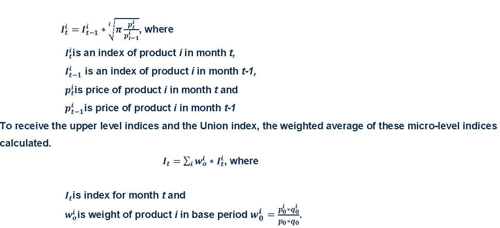
The 2012 base year computes CPI by using the
following Modified Laspeyres's Price Index formula:
Commodity Basket
Commodity basket also called basket of goods. A collection
of products, raw materials and services which are comprised
the Consumer Price Index (CPI) over a period. The basket typically
indicates consumer buying behavior across a diverse set of
offerings.
The 2012 CPI introduces the UN COICOP classification.
The classification is used internationally possible to make
international comparison of inflation at more detailed levels.
The 2012 CPI basket has 274 products and services, 108 food
items, 166 non-food items including goods and services. There
are new 116 items in the index, for example new and used cars,
mobile phones and mobile phone charges and computers, etc.
2012 CPI based on only non-purchased items are excluded from
total expenditure.
Inflation
An increasing overall level
of prices is rising in the long period.
Inflation Rate
The percentage increase in the price of goods and services,
usually, annually. The inflation rate means the average price
of commodities has risen for a long period of time, that situation
refers total demand is higher than total supply. In other words,
the inflation rate shows climbing price index.
When the inflation rate is high, the value of a unit
of currency is reduced and larger sums of money are required
to purchase the same quantity of goods or services. This rise
in the general price level and reduction in the real value of money is inflation.
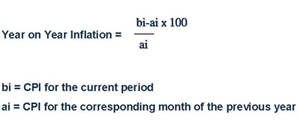
Year on Year Inflation
The Inflation can be measured by
computing percentage change in current month CPI from month
to month or percent change from the same month of the prior
year, according to the following formula:
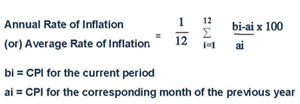
Annual Rate of Inflation (or) Average
Rate of Inflation
The average rate of inflation is computed
monthly CPI growth rate within a year taking 12 month of year,
according to the following formula:
Gold Price Gold prices are collected from gold dealer by daily
for the highest, lowest, and the average prices of 24 carat
and 22 carat gold in Yangon.
Cooperative Statistics
Statistics on cooperative activities are provided by the Cooperative
Department. The major objective of cooperative society is to
procure, produce, and distribute essential goods and services
to the consumers through the respective cooperative societies.
Cooperative statistics shows the number of societies, number
of members paid-up share capital, bank loan, reserve fund,
other fund, liabilities, net profit, and working capital from
cooperative societies.
CHAPTER 16. PUBLIC FINANCE, BANKING AND FINANCIAL MARKETS
Public Finance
The Republic of the Union of Myanmar Budget has
been classified into the Union Budget and State and Region Budget
since 1st October 2011-2012.
Nay Pyi Taw Development Committee is drawn on the basis of
self-financing since 2006-2007.
Some of the state-owned Economic Enterprises under the Ministry
of Transport have been carried out their functions outside
the Union Fund and Yangon Electricity Supply Corporation since
2013-2014 and Mandalay Electricity Supply Corporation have
been carried out their functions with their own fund since
2015-2016.
Social Security has been carried out their functions outside
the Union Fund except for services personal wages and salaries
since 2013-2014.
Central Bank of Myanmar is carried out its functions with its own fund beginning from 2015-2016.
State Economic Enterprise (SEE) budget is included in umbrella of the Union Budget. In 2018 (6) month Fiscal Year there was 32 State Economic Enterprises (SEEs). Among these 32 SEEs, 20 SEEs have been used Own Fund Account and SEE Account, 7 SEEs that are Financial Institutions which have been used only SEE Account and other 5 of SEEs are outside of the union fund which have been used Current Account.
If SEE get profit, 25% of the net profit are paid as income tax, 20% of net profit are put into the Union Fund as state contribution.
According to the Agreement of the Cabinet meeting, changed the fiscal year from October 1 to September 30 instead of April 1 to March 31 and it recorded by second session of the Pyidaungsu Hluttaw.
Government Debt Stock
Government debt stock refers to the total value of the government
debt that a government owes to all external and domestic lenders.
Domestic Debt Stock
Domestic debt stock is the debt that the government owes to
Central Bank of Myanmar, domestic banking sector and individuals.
External Debt Stock
External debt stock is the debt that the government owes to foreign lenders like ADB, World Bank and etc.
Repayment Principle
Repayment Principle is the remaining amount of the periodic
payment that is used to reduce the outstanding loan amount.
Money Supply
Money Supply is the total value of money available in an economy
at a point of time. There are several ways to define money such as M1, M2 and M3, etc.
Money Supply (M1) or Narrow Money covers currency outside depository
corporations and transferable deposits at banks.
Currency outside Depository Corporations
Currency outside Depository Corporations is the domestic currency
included in broad money and is complied as currency in circulation
less currency holdings in the vaults of other depository corporations (banks).
Transferable (Demand) deposits
Transferable (Demand) deposits comprise all deposits that are exchangeable
on demand at par, without penalty or restriction, and that are otherwise
commonly used to directly make payments.
People's Savings(Other Deposits)
People's savings or other deposits comprise all claims,
other than transferable deposits, that are represented
by evidence of deposits. It includes saving deposits,
time deposits, saving certificates, and other types of deposits.
Foreign Exchange Rates
Starting from 2012-2013, managed floating foreign
exchange rate is used. Starting from 1st April 2013,
the daily reference foreign exchange rates are obtained from Central
Bank of Myanmar.
Since 5 February 2019, the Reference Exchange Rate of Myanmar
Kyat equivalent to one unit of the US Dollar is computed and published
by the Central Bank of Myanmar on its website every bank business day at 16:00.
The Reference Exchange Rate is calculated based on weighted average rate of
the spot trades by the banks on the daily Foreign Exchange market during the
calculation period (from 9:00 to 15:00 of the calculation day).
The Reference Exchange Rate is an indicative rate and participants in the foreign
exchange market are not required to use it in their foreign exchange transactions.
The Reference Exchange Rate of the previous bank business day can be used for settling
customs obligations, accounting and statistical purposes.
Treasury Bonds
Issuing Government Treasury Bonds before 2016
On behalf of the Government, the Central Bank
of Myanmar (CBM) has issued the 3-year and 5-year Government Treasury
Bonds since 1993. On January 1, 2010,CBM issued 2-year Government
Treasury Bonds and the interest rates of 2- year, 3-year and 5-year
Government Treasury Bonds are 8.75 percent, 9 percent and 9.5
percent respectively.
Issuance of Government Treasury Bills and Bonds by Auction
In order to reduce CBM Financing, the Government Treasury Bill has been issuing since January 28, 2015 and Bond has been issuing since September 20, 2016 with Scripless System in line with the international standards. According to the Agency Agreement between Ministry of Planning and Finance (MoPF) and CBM, CBM is acting as the agent of MoPF but Treasury Department manages all process on behalf of MoPF for the issuance of Government Security.
Multiple price system for competitive bidders and Market Weighted Average Yield for non-competitive bidders has been practiced in Treasury Bill and Bond Auction.
In Government Securities Auctions, there are two types of bidders, Competitive and Non-Competitive Bidder. Myanma Economic Bank is only one Non-Competitive Bidder which is the largest amount invested in Treasury Security and other State-Owned Banks, Local Banks, Foreign Banks and Securities Companies are Competitive Bidders. Insurance Companies, Institutional Investors and Individual Investors can purchase Government Securities through the Securities Companies. All information related to Government Securities Auction (including Auction Calendar, Auction Announcement, Auction Result, and Related Documents) are uploaded on the Website of CBM and the Website of MoPF.
Government Treasury Bill with the maturity of 3-month, 6-month and 1-year have been issued and the total Auction is 100 times up to May 2019. Government Treasury Bond with the maturity of 2-year, 2 and half year, 3-year, 4-year and 5-year have been issued and the total Auction is 33 times up to May 2019.
Interest Rates
Central bank rate, interest on treasury bills and bonds, deposit
rates and lending rates are shown in table 16.19.
Central Bank Survey
Central Bank Survey in table 16.20 shows the components of monetary base and its assets that are compiled based on the Central Bank's balance sheet data.
Other Depository Corporations Survey
Other Depository Corporations' Survey in table 16.21 shows the assets and liabilities positons that are compiled based on the consolidated balance sheets data of domestic banks which are Myanma Economic Bank, Myanma Foreign Trade Bank, Myanma Investment and Commercial Bank, Myanma Agricultural Development Bank, Private Banks and Foreign Bank Branches.
Foreign Exchange Reserves
Foreign Exchange reserves in table 16.22 include
gold and foreign currencies. Previously, gold was valued at SDR
35 per fine troy ounce and converted into Kyat at the official
exchange rate of K 8.50847 per SDR. Since 1997, the value of gold
in the foreign exchange reserves has been based on London Gold
Market rate. Foreign currencies are valued at the reference rates.
Depository Corporations Survey
Depository Corporations Survey consolidates the Central Bank Survey and the Other Depository Corporations Survey. In table 16.23 it shows the monetary aggregates positions, and assets that are claims on other sectors of the domestic economy.
|